By Cecilie Mauritzen, Chief Scientist, the Kon Tiki 2 Expedition, Lead author of the 4th and 5th Assessment Reports of the Intergovernmental Panel on Climate Change
About the Kon Tiki 2 Science Program
When the two rafts of the Kon Tiki 2 Expedition sailed from Lima in November they were equipped for full-scale ocean and climate research. During the two legs – Peru to Easter Island before Christmas and Easter Island to Peru after Christmas – the rafts will make thousands of measurements in order to understand how changes in marine life relate to climate change and ocean pollution. The expedition takes place during the El Nino of 2015/2016, a fortunate fact which will deeper insights into the interactions between the marine ecosystem and the changing marine environment. It also takes place during the 21st Conference of the Parties to the United Nations Framework Convention on Climate Change, which makes it timely to "give the ocean's a voice". So what will we measure on our trip?
Oceans play an important role in global climate dynamics. Oceans have absorbed more than 90% of the heat that has accumulated in the atmosphere due to global warming. About a quarter of all the carbon dioxide (CO2) emitted from the burning of fossil fuels has been absorbed by oceans, making the oceans an efficient buffer of global warming. When the algea are done with their "carbon capture and storage" – absorbing CO2 to create oxygen, then dying and being buried at the sea floor – the remaining CO2 turn into its evil alter ego: ocean acidification. And to top it off, oxygen content in the oceans is dropping. All these changes pose risks for marine life and may affect the oceans' ability to perform the wide range of functions that are vitally important for environmental and human health.
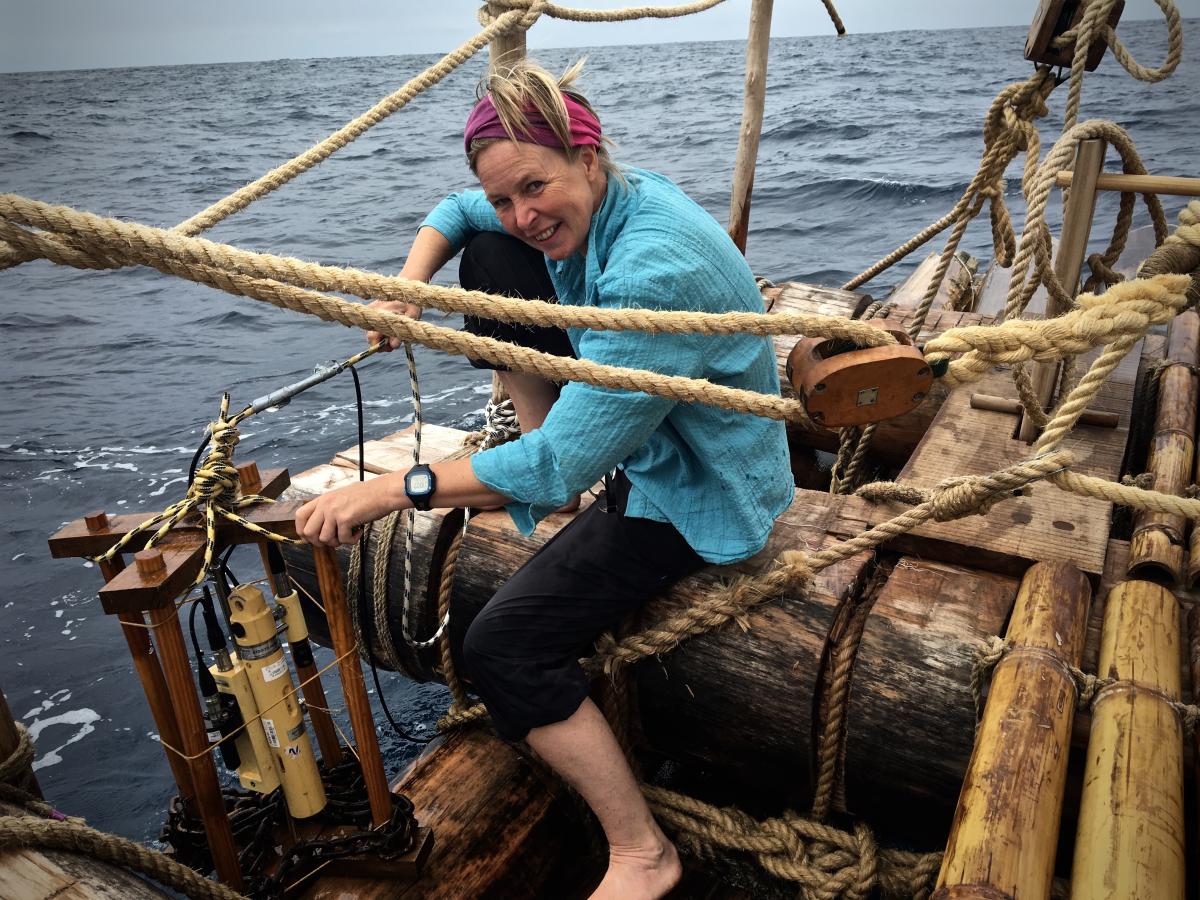
We carry a variety of instruments to monitor climate change, acidification and deoxigenation: pCO2 sensor, pH sensors, Oxygen sensors, Temperature and salinity sensors etc.
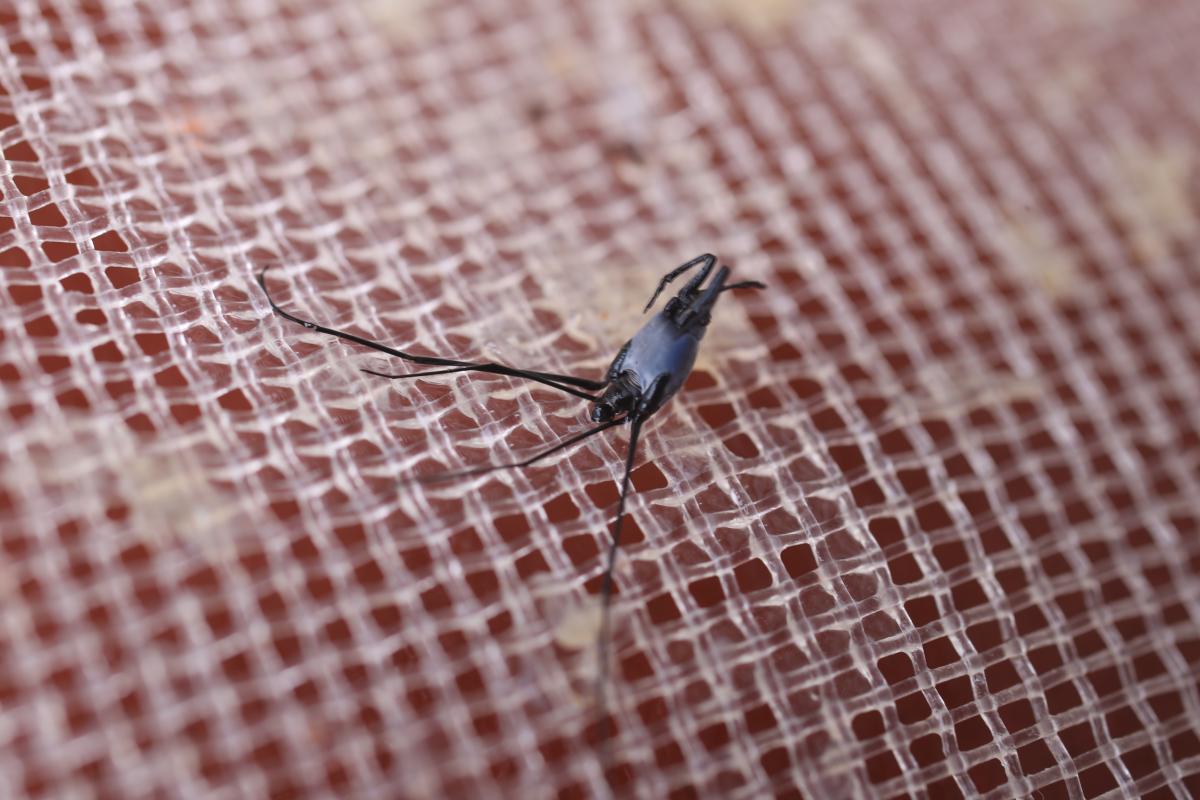
The pictures show the CTD above and underneath our raft.
Contact Persons on shore: Emanuel Reggiani <Emanuele.Roberto.Reggiani@niva.no>, Geir Johnsen <geir.johnsen@bio.ntnu.no> and Kai Sørensen <kai.sorensen@niva.no>
The climate summit COP21 takes place during our voyage; we will do our best to convey loudly what we know – and what we observe out in the southeast Pacific – about climate change in the World Oceans.
2: Marine litter: Plastic and microplastic pollution
The path takes the expedition through one of the large garbage accumulation zones of the world oceans (so-called "gyres"), so high-tech and low-tech instrumentation will be brought along to identify and quantify macro- and micro plastics. Micro plastics are regulated by UNEPs Stockholm convention (a global treaty to protect human health and the environment from persistent organic pollutants, POPs). We have only limited information about the composition of the litter, its seize distribution, and its interaction with the pollutants of UNEPs Stockholm convention.
Marine litter will be sampled during the transect by using a Manta Trawl sampling macro and micro plastics larger than 300μm. In addition a newly developed stationary 3 Stage Pump sampler will be used to study the size distribution of the plastic and identify which sort of plastics or polymer materials we find. This will be the first time size distribution data have been obtained in any of the 5 Gyres.
The Manta Trawl and its findings
On the raft, identification of the macro and micro plastics (down to 1 mm) from the trawl or the 3-stage sampler will be done by using micro Near-Infrared (NIR) camera equipment and analyzed in near-real-time by NIVA. Filter samples from the 3-stage pump sampler down to 50 μm will be stored for further analysis by high resolution NIR in the laboratory. These samples will also be analyzed for the persistent organic pollutants (POPs) regulated by the Stockholm convention. One of the research objectives here is to establish the role of plastics in transporting POPs to remote areas of the World Oceans. The pollutants move preferentially from the water phase to the plastics – and this makes these pollutants more mobile and more assessable for wildlife.
The pictures show how the three-stage sample is deployed from the raft
Contact person on shore: Bert van Bavel <bert.vanbavel@niva.no<
3: El Nino and operational weather forecasting
In the equatorial Pacific, the ocean and atmosphere is strongly coupled; the there is a strong feedback between changes in the atmosphere and changes in the ocean. The "normal" state can last for several years, but during an El Nino year, as we are in the midst of now, the surface ocean in the eastern Pacific becomes significantly warmer and the winds, the surface currents and the precipitation patterns also changes. The marine ecosystem responds strongly – collapse of the coastal fishery along the Peruvian and Chilean coast was probably the first, ancient, indicator of this strong climate signal.
During our voyage, El Nino will of course affect us. Theoretically, we can expect slower winds, slower currents and more precipitations than usual. But reality never quite follows expectations, so we are prepared for surprises.
We depend on high-quality weather forecasts, so we will contribute directly to the World Weather Watch - the core programme of the World Meteorological Organization – by transmitting meteorological data from our own weather station every three hours. Weather forcasting centers around the world depend on meteorological observations from voluntary ships to make good forecasts, and considering how few ships sail in the southeast Pacific we feel certain we can make a difference.
Contact person on shore: Aslaug Mariolijn van Nes <aslaugmvn@met.no>
Contact on shore: Tom Christian Ambrosius Mortensen <TomChristianAmbrosius.Mortensen@nortek-as.com>
4: Marine Life
The marine ecosystem is under tremendous threat due to the many changes happening to the marine environment: marine litter, toxic chemicals, ocean warming, ocean acidification, ocean de-oxygenation to name a few. This multitude of stressors is having a major impact on marine habitat all around the world and the Kon Tiki 2 expedition carries instrumentation to monitor the entire ecosystem, from the smallest phytoplankton to the grandest of sea animals.
Phyto (aka "plant") plankton is the ocean's "grass" - they exist at the bottom of the marine food chain, produce half the oxygen we breathe and is the only organism in the ocean that actually absorbs CO2 (natural CO2 sequestration takes place when these die and sink to the bottom) and convert it to food (biomass or organic C). The well-proven “secchi disk” lets us measure ocean color and planktonic algae directly. In addition we will carry an experimental pump (filtration of water samples), as well as turbidity and chlorophyll sensors on our surface Conductivity-Temperature-Pressure (CTD) unit. With the addition of remote sensing of ocean color from satellites, these dataset will give us quantitative insights into the condition of the oceans “grass” along our sailing track.
Ps: On the return voyage we will carry two additional state-of-the art instruments to further quantify phytoplankton components and health (stay tuned, or contact Geir Johnsen at NTNU for a sneak review).
Contact persons on shore: Kai Sørensen <kai.sorensen@niva.no> and Geir Johnsen <geir.johnsen@bio.ntnu.no>
Moving up in the food chain to the zooplankton and beyond, we will be crossing many very different types of marine environments with their own ecosystems. We will even be creating our own ecosystem: rafts typically serve as magnets to marine life.
We seek to understand how such a platform is colonized and how this colonization evolves during a rather long period. So far indeed, we have information only from fast moving ships, where what we see is animal (fish and plankton) spatial distribution in a given instant, with no idea of behavioural interaction in time. Secondly we seek to observe potential changes in the fish community as a consequence of changes in the characteristics of the marine environment, caused by climate change, plastics, toxins and so forth.
We carry two Kongsberg Echosounders, with frequencies 70 and 200 kHz, to monitor the animal life along the way. Contact person on shore: Frank Reier Knudsen <frank.reier.knudsen@km.kongsberg.com>
Superbly important
Oceans create half the oxygen (O2) we use to breathe. Oceans provide almost 20% of the animal protein consumed by the world’s human population. Oceans are home to species and ecosystems valued in tourism and for recreation. The rich biodiversity of the oceans offers resources for innovative drugs or biomechanics. Ocean ecosystems such as coral reefs and mangroves protect coastlines from tsunamis and storms. About 90% of the goods the world uses is shipped across the oceans. The oceans are attractive to people all over the world, no matter race, nationality or religion. The oceans are superbly important to our well-being. Yet they are under tremendous stress, primarily caused by mankind.
Unique opportunity
The rafts will function as excellent research platforms. The deck is very near the sea surface so it is easy to make measurements; they move slowly so the observations will be closely spaced, and though we will be busy with testing our sailing skills, we will have plenty of time to operate the large battery of scientific instruments on the two rafts. Opera Software, with CTO and crewmember Håkon Wium Lie, secures solar power and satellite communications for the research program. Never has a full-scale oceanographic research program been undertaken based on exclusively renewable power!
(2015-12-21) We are at Easter Island! Rapa Nui :) aka Paradise! We arrived in the morning of
December 19, and I think everyone is ready for shore. Science wise we have had a
great success: we have obtained hundreds of samples and thousands of
measurements, using practically every instrument we brought along. Now I can't
wait to get back to Oslo and start the best part of science: the analysis and
synthesis. On a personal note, I am proud to announce that early next year I
will become chief scientist at NIVA, at the interface of water & climate. NIVA
has been the leading scientific partner for the Kon Tiki 2 expedition, so this
will be really fun.
But the expedition is only half done. Pedro de la Torre from NTNU will sail
Chief Scientist on the return leg, a leg that promises to be much tougher than
the one we just completed. Pedro is a highly skilled ocean engineer and
biologist, so the operation will be in the best of hands. Pedro can be reached
on my old email address: science.kontiki2@myiridium.net. I wish Pedro and the
rest of the return crew the very best of luck and smooth sailing :)
The agreement in Paris
(2015-12-14) Very good friends in Arizona, USA, have asked about my take on the final agreement
at the climate summit COP21 in Paris. So Bob and Stew, here's for you:
I think we can allow ourselves a little breather, a little celebration, a renewed
belief in the large, slow, bureaucratic UN system: an agreement WAS reached in Paris
last week, and it included all, not just a handful of countries. And: the agreement
reflects quite clearly that science has been heard: someone, many, must have read
the IPCC assessments, and taken their findings into account. I refer specifically to
the idea that emissions must peak as soon as possible. This statement is linked to
the IPCC key finding that there is a finite CO2 budget for any given temperature
increase. No one should be in doubt after this that fossil fuels will have to be
phased out.
What is not so great is the idea that within the second half of the century the
emissions can not be larger than what can be absorbed by ocean and forests
collectively. Well, it is great for the atmosphere: its CO2 content will have peaked
and thus its temperature increase will slow. But it is not so great for the ocean:
as discussed in these pages already, the ocean has already received more than it can
take of manmade CO2.
But as I said, let us allow ourself a little celebration. And then continue telling
the ocean's story in the new year.
Scientists unite! No more assessment without action!
Based on the earlier blog What the ocean would have said at COP21 I just received
an interesting challenge from Heidi and Heikki Niskanen in Finland. This wonderful
couple were part of the raft building team in Peru. And now, from their warm house
in winter Finland they ask: What would Cecilie have said at COP21?
So here is my response:
If I were to address the climate summit COP21 in Paris, what would I do? ... hmm ...
I would speak out as a climate scientist, a representative of the natural sciences,
one of many very frustrated colleagues. And I would speak of the seemingly hopeless
task my colleagues and I are charged with: to produce assessment after assessment
for the United Nations through the Intergovernmental Panel on Climate Change (IPCC)
to be delivered to this body, the Conference of the Parties, as background material
on the state of knowledge of the questions you are here to make decisions about.
Frustrated, because the knowledge is as sound as it will ever be. And at the same
time: frustrated, because you will never accept the knowledge is sound enough to
base a decision on. From the bottom of my heart I want to scream: Scientists unite!
No more assessment without action!
And I would talk my friend the ocean into joining me in this appeal. The ocean,
which quietly receives the hardest beating of climate change: warming, acidification
and de-oxygenation providing a triple punch which already is raising havoc with the
marine ecosystems. It is not the ocean's habit to speak in a loud voice, but I
would talk him into it. And then I would try to convince all those that depend on
the ocean to speak out too: Get on with it, make a decision, we need action now!
Climate change will change the foundations upon which we base and trust our lives.
Scientists unite! No more assessment without action!
(2015-12-07) Now that we have managed to make a deep-water cast, thanks to the hard, dedicated
work by the crew on Tupac, it is time to reflect a bit on the importance of such
deep-water measurements. There are many ways to make measurements at the sea
surface: you can place sensors on satellites and they can measure anything from sea
surface height to chlorophyll and salinity. You can put sensors on instruments you
bring out to sea, and you simply tie the instrument to the side of the ship. We have
many such sensors tied to our raft. And you can analyze the water directly, using a
variety of chemicals, alternatively bring the samples back to shore for further
analysis as we will do.
But below the sea surface electromagnetic waves won't travel, so to measure
conditions over long distances you need to use sound-waves. We have two devices using
sound-waves on board: the current meter, which measures the ocean current in the
upper 20 meters under the raft. And the echo sounder, which measures animal life
down to 1000 meters. What you actually measure depends a lot on the choice of
frequencies and power.
But sometimes you want to know precisely the value at given places in the water
column, and in that case you are best off sending the instrument to that place.
Which is what Tupac did yesterday :). Measurements of temperature, salinity,
chlorophyll and oxygen every few centimeters down to 1000 meters depth. They
measured the top layer, very well mixed by the winds, full of oxygen and with a
lovely swimming temperature of 22 degrees Celsius. Beneath this the crossed the
first oxygen minimum zone, between 100 and 200 meters. Then, continuing downwards,
the temperature and salinity would have stayed relatively homogeneous for a while
(warm and salty), until the next oxygen minimum is reached at about 1000 meters.
Beneath this, around 2000 meters the waters start getting very cold, and by the
time you are below 3000 meters you're down to two or three degrees. But even these
cold water-masses have experienced warming due to climate change!
It is very hard to make such deep water measurements from a balsa raft.Just the rope
needed to get down to the bottom takes lots of space. And the power needed to bring
the instrument up is enormous. So I'm very proud of the Tupac crew who made a
successful attempt and got to 1000 meters. And I'm cheering them on to make a new
try, for two thousand meters. In that case we will establish the oxygen content and
extent of BOTH oxygen minimum zones out in the middle of the southeast Pacific in
this hefty El Nino year 2015 :)
What the Ocean would have said. On oxygen @ cop21
Dear delegates, dignitaries, ladies and gentlemen,
It is a great honor to be given the floor at the 21st Conference of the Parties here
in Paris – a meeting of enormous consequences for Earth, its elements, and all its
creatures, great and small. The agreements that are reached at the 2015 climate
summit will have consequences for times so far into the future that only the ocean
and the mountains will remember.
Today I wish to turn your attention to an aspect of climate change that you have
quite possibly never considered. It is an issue of great importance and grave
consequences for the ocean, namely that of oxygen depletion. You may not know this,
but the animals in the ocean need oxygen to live, just like the animals at land.
And, as on land, it is the plants that produce the oxygen. In fact, the ocean
normally produces much more oxygen than it needs, and therefore shares its oxygen
with the animals in land, including you humans. Nearly half the oxygen you use
originates in the ocean. So you see, we, the Ocean, provide a great service as
oxygen producer to all Earth's creatures, wherever they live.
And I tell you about this because I fear that we, the Ocean, cannot continue to
provide this service at the same high standard much longer. We cannot even supply
enough oxygen for our own creatures anymore. "Why?" you may ask. Well, the ultimate
reason is the emission of carbon dioxide associated with combustion of fossil fuels.
This emission creates temperature increases in the ocean, just like on land. And
when the surface ocean gets warmer it gets more buoyant, making it difficult to mix
the surface waters with the deep water. Here it gets a little complicated, but no
less important: the ocean plants that produce the oxygen live in the surface waters.
Less mixing by the winds means less oxygen transported downwards, to where the ocean
animals need it. And less mixing means fewer nutrients coming up from the deep ocean
to provide food for the ocean plants. Less food means fewer plants and thereby even
less oxygen production. This is a worrysome trend that we, the Ocean, worry
deeply about, not just because it affects our own creatures, but because it affects
all Earth's creatures, great and small, rich and poor, women and man, child and old.
There is only one way to stop this worrysome trend, namely to curb the emissions of
carbon dioxide. Every day and every year that you postpone this decision, we, the
Ocean, weakens and our services – which you all depend upon – deteriorate. We beg
of you: if not for us, then your you, make a decision. Produce an agreement at this
summit that will put us, the Ocean, back on the path towards health, so that we can,
once again, be the top quality oxygen producer that all Earth's creatures, great and
small, depend upon.
Thank you kindly for listening.
Most humbly,
We, the Ocean.
What would the Ocean have Said?
Thoughts at the dawn of the 2015 Climate Summit in Paris
What is it about nature? Why is it so beautiful? Why is it ALWAYS so beautiful? Why
does it hide so well all its scars and bruises? Why does it let us get away with it
all?
I sit on a balsa raft in the Pacific Ocean, leisurely sailing from Peru to Easter
Island. I watch the swells go by, the sun come and go, the small squalls pass by,
the winds steadily blowing out of the southeast, allowing us, just barely, to steer
so far upwind that we have a justified hope of reaching Easter Island before
Christmas. In fact, we are two rafts, and both are packed to capacity with research
equipment to document the state of the southeast Pacific during this (southern
hemisphere) spring, which happens to be in a gigantic El Nino year.
One of the rafts, the Tupac Yupanqui, is dedicated to monitoring plastic pollution.
We are crossing one of the five major plastic accumulation regions ("gyres") of the
World Oceans, and we have brought many different instruments to acquire a solid data
base on this year's gyre. But what do we see? Nothing. Nada. Okey, a coke bottle
twice so far, but otherwise: not one thing. The steady, intense winds have
efficiently mixed down the plastic so that it looks just as gorgeous as it did 70
years ago when Thor Heyerdahl crossed these seas with the Kon Tiki. "Our" Pacific is
probably a bit greyer than the blue colors his crew so eloquently described, but
that's because of the weather, not because of some color contamination.
Our instruments will be able to detect particles smaller than the human eye can see,
and will be able to record with high precision what the broken-down plastic - the
microplastic - consists of and where it most likely came from. Our research
therefore adds to the never-ending, painstaking collecting of data that has been the
task of the scientist since times immemorial. And microplastic is one of those
particularly insidious pollutants; it attracts toxins and it folows the food web of
the marine ecosystem, thus slowly poisoning the entire chain. But it doesn't really
matter what the scientist collects, does it? Because no one can see it. Can't see
the plastic in the oceans nor the poison in the animals. The ocean is gorgeous. And
the animal life is up to par. I see dolphins, dorados, whales, flying fish and a
multitude of birds. In fact, our raft has turned into its own little ecosystem which
we monitor with cameras every day. To us, the marine life looks nothing but happy.
My raft, the Rahiti Tane, is packed with equipment to monitor climate change. We
measure ocean temperature, ocean CO2-content, ocean oxygen content, ocean acidity.
We know the oceans are behaving like a huge buffer in Earth's big effort to mitigate
climate change: the oceans take up a third of all the CO2 that mankind emits every
year. And it takes up almost all the heat created by climate change. Almost all!
Sure, the global atmospheric temperature is rising, decade by decade, with all its
consequences in terms of heat waves, extrem weather, floods and droughts. But that's
only a few percent of the heat accumulated on Earth. More than 90 % of that heat is
stored, each year, in the oceans. How is that for an efficient buffer? Without the
oceans we would already be facing much harsher changes due to climate change. The
oceans spare us from facing reality. Damned nature.
Meanwhile I rock gently back and forth on my raft – the Rahiti Tane, so full of
personality and crewed with such a lovely croup of people – genuinely proud to be
running a full-scale research program purely on solar power. I think of all the
interesting research questions I get to address. My only concern is that we are
running out of fuses. (Well, and that we are almost out of chocolate...). And then
the thought strikes me: this is all in vain. Nobody will care. There cannot possibly
be anything wrong with something so beautiful. Damned nature.
Could the ocean, even if it were sitting at the negotiating table at the climate
summit in Paris, arguing for the strong climate agreement it really needs, convince
anybody to sign anything? I do not know. Because the ocean is SO beautiful. But what
would it have said? Now, THAT is an interesting question.
Sunshine!
(2015-11-24) It is Tuesday November 24, we are west of 90 W, and we have entered a new type of
weather, after being pounded with strong southeasterlies, huge swells, and cloudy,
humid conditions for more than two weeks. Today was sunny, calm and wonderful. So
sunny in fact, that we pulled out yet another instrument from the Rahiti Tane
toybox. In this case a "Microtop" to measure aerosol optical depth of the atmosphere
over oceans. These instruments require a clear view of the sun, so ours had so far
been collecting dust.
With the Microtop measurements we participate in a global network
of 500 voluntary ships who contribute to monitor how the aerosol
content of the atmosphere changes with space and time. The program is
coordinated by NASA.
Remember, these particles have an overall cooling effect on the
atmosphere, but regionally they can have a huge impact on how
temperature and even precipitation varies from place to place. So
that's why it is so important that the voluntary ships keep collecting
their data, year in and year out. And today, we did our little part :)